

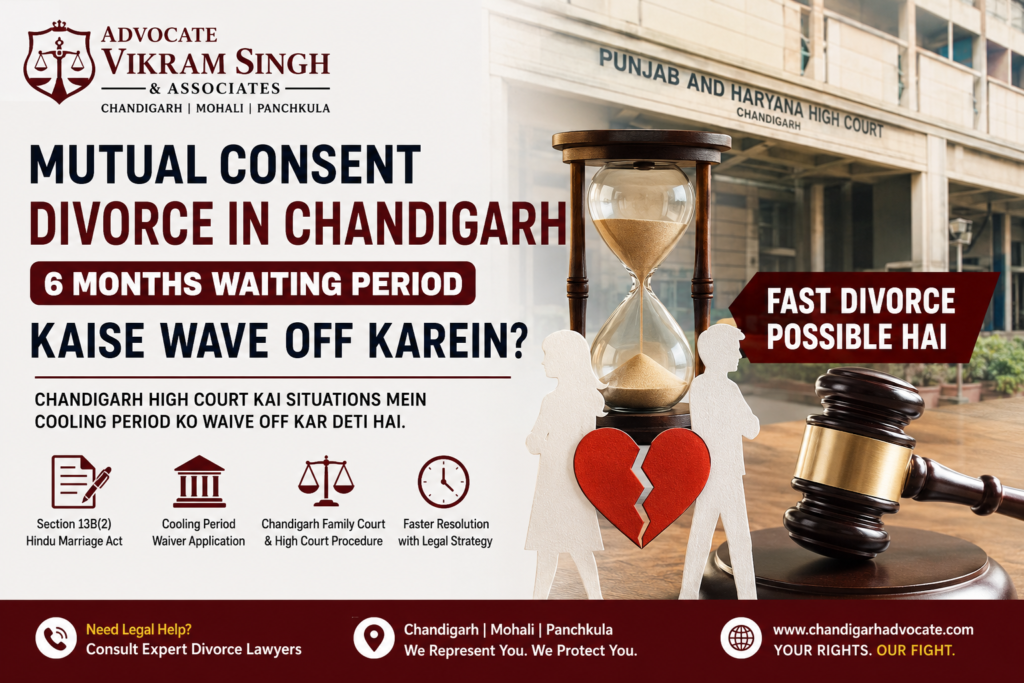
Mutual Consent Divorce in Chandigarh: Cooling Period Waiver, Procedure & Family Court Guide
Mutual consent divorce in Chandigarh is often the quickest and least contentious method of ending a marriage. Many couples believe they must always wait six months after the first motion before obtaining a divorce decree. In reality, the Family Courts at Chandigarh and Panchkula, as well as the Punjab & Haryana High Court, can waive the cooling period in appropriate cases. This guide explains the law, procedure, documents required, waiver conditions, and a real Punjab & Haryana High Court case illustrating how the process works in practice.
Mutual Consent Divorce in Chandigarh: An Overview
A mutual consent divorce is filed under Section 13B of the Hindu Marriage Act, 1955. Unlike a contested divorce, both spouses jointly agree that the marriage has broken down and should be dissolved. This process is frequently preferred by couples in Chandigarh, Mohali and Panchkula because it reduces litigation, minimizes conflict, and allows issues relating to alimony, maintenance, child custody, visitation rights and property disputes to be settled amicably.
For many couples, a properly structured mutual consent divorce offers closure without years of litigation. However, understanding the legal requirements and cooling period provisions is essential before initiating proceedings.
What a Mutual Consent Divorce Involves
- First Motion: A joint petition is filed and statements of both spouses are recorded.
- Settlement: Issues relating to maintenance, permanent alimony, custody, visitation, stridhan and property are settled.
- Second Motion: Both parties reaffirm their consent and the court grants the decree.
One essential requirement is that the parties must have been living separately for at least one year before filing the petition.
How Long Does a Mutual Consent Divorce Take in Chandigarh?
Ordinarily, a mutual consent divorce proceeds through two motions. Where the statutory cooling period is not waived, the process generally takes six to eight months after the first motion. However, where the legal requirements are satisfied and reconciliation is no longer possible, the Family Court may waive the waiting period, allowing the matter to conclude significantly earlier.
The Section 13B(2) Cooling Period
Section 13B(2) of the Hindu Marriage Act requires the parties to return for the second motion after a minimum period of six months and before eighteen months from the first motion. The object of this provision is to provide an opportunity for reconciliation and prevent impulsive decisions.
However, where the marriage has already broken down beyond repair and all disputes stand settled, insisting upon a six-month wait may merely prolong hardship. Courts have repeatedly recognized this practical reality.
When Can the Cooling Period Be Waived?
| Requirement | Explanation |
|---|---|
| Separation | The statutory separation requirement has already been satisfied. |
| Failed Reconciliation | Mediation and conciliation efforts have failed. |
| Complete Settlement | Issues of alimony, maintenance, custody and property stand resolved. |
| No Useful Purpose | Further waiting would only prolong the suffering of the parties. |
A waiver application is typically filed shortly after the first motion and must clearly establish the above circumstances.
Supreme Court Decision: Amardeep Singh v. Harveen Kaur
The leading judgment governing cooling period waivers is Amardeep Singh v. Harveen Kaur (2017) 8 SCC 746. The Supreme Court clarified that the six-month period under Section 13B(2) is directory and not mandatory. The Family Court itself has the authority to waive the period where the facts justify such relief.
The Court emphasized that waiver may be granted where separation requirements have already been satisfied, settlement terms have been finalized, reconciliation has failed, and waiting would only prolong hardship.
A Real Punjab & Haryana High Court Case from Panchkula
A useful illustration emerged from a matter involving spouses who married in February 2019 according to Hindu rites. Due to temperamental differences, they began living separately from March 2020. Despite efforts at reconciliation, the marriage could not be saved.
The parties eventually filed a petition for mutual consent divorce before the Family Court at Panchkula. Their statements were recorded during the first motion. Since all disputes had already been settled, they applied for waiver of the cooling period.
The Family Court declined the request. The parties thereafter approached the Punjab & Haryana High Court under Article 227 of the Constitution.
Justice Arun Monga personally interacted with both parties and found that they had consciously decided to dissolve the marriage, had settled their disputes voluntarily and were acting without coercion.
The High Court held that insisting upon a further waiting period would serve no meaningful purpose. The Family Court’s order was set aside and directions were issued to proceed without insisting upon the six-month wait.
This decision demonstrates that where the legal requirements are satisfied, courts are willing to adopt a practical approach rather than prolong litigation unnecessarily.
Why Courts Refuse Cooling Period Waiver Applications
- Incomplete settlement regarding maintenance or custody.
- Insufficient proof of separation.
- Possibility of reconciliation still exists.
- Statements of parties reveal uncertainty.
- Settlement terms appear unfair or unclear.
A carefully drafted settlement deed and waiver application often play a decisive role in the outcome.
Procedure Before the Chandigarh Family Court
- Preparation of mutual consent divorce petition.
- Execution of settlement deed.
- Filing before the Family Court.
- Recording of first motion statements.
- Filing waiver application, if appropriate.
- Second motion hearing.
- Grant of decree of divorce.
Mutual Consent Divorce for NRIs in Chandigarh
NRI spouses frequently seek mutual consent divorce before courts in Chandigarh. Depending upon the circumstances, courts may permit participation through video conferencing or through a duly authorized attorney. Proper planning becomes especially important where one spouse resides abroad.
Documents Usually Required
- Marriage certificate or proof of marriage.
- Identity proof and address proof of both parties.
- Photographs.
- Proof of separation.
- Settlement deed or Memorandum of Understanding.
- Financial disclosures where relevant.
- Child custody arrangement, if applicable.
Common Mistakes to Avoid
- Leaving financial issues unresolved.
- Failing to document settlement terms properly.
- Providing inadequate evidence of separation.
- Filing a waiver application without supporting facts.
- Relying on oral understandings rather than written agreements.
Frequently Asked Questions
1. Is the six-month cooling period mandatory?
No. The Supreme Court has clarified that it is directory and may be waived in appropriate cases.
2. How soon can a waiver application be filed?
Generally after the first motion, subject to the facts of the case.
3. Can NRIs obtain a waiver?
Yes, provided the legal requirements are satisfied.
4. Can the Family Court itself grant the waiver?
Yes. The Family Court has jurisdiction to waive the cooling period.
5. What happens if one spouse withdraws consent?
The mutual consent divorce petition cannot proceed.
6. How much time does a mutual consent divorce take in Chandigarh?
The timeline varies, but waiver may significantly reduce the duration.
7. Is a settlement deed necessary?
While not mandatory in every case, a clear written settlement is strongly advisable.
8. Can maintenance be waived?
Yes, if both parties voluntarily agree and the court finds the arrangement acceptable.
9. Can child custody be settled through mutual consent divorce?
Yes. Custody and visitation terms are frequently incorporated into settlement agreements.
10. Do I need a divorce lawyer in Chandigarh?
Professional legal assistance helps ensure compliance with procedural requirements and protects long-term interests.
Conclusion
For couples considering a mutual consent divorce in Chandigarh, understanding the cooling period waiver provisions can substantially reduce delays. The courts recognize that where a marriage has irretrievably broken down and all disputes stand resolved, insisting upon an additional waiting period may serve no useful purpose. Proper drafting of the petition, settlement deed and waiver application remains essential for achieving a smooth and dignified resolution.
Considering a Mutual Consent Divorce in Chandigarh?
Advocate Vikram Singh & Associates regularly represents clients before the Punjab & Haryana High Court, Chandigarh Family Courts, Panchkula Courts and related forums in matrimonial and family law matters.
Call: +91 99881 70779 | +91 70879 30779


