

Divorce Advocate in Chandigarh
Advocate Vikram Singh and Associates is a trusted name among the top law offices in Chandigarh. As a leading Divorce Advocate in Chandigarh and our legal team is having good experience in field of family law. We have built a strong reputation for handling love marriage, family law, and divorce-related cases in chandigarh with professionalism and provide best results.
Our law firm has successfully represented many couples in inter-caste and inter-religion love marriages before High court, Chandigarh. We had secured timely protection orders from the Punjab and Haryana High Court, when families or society oppose the relationship. We also handle urgent matters like threats to safety and ensure immediate legal Protection from High Court.
If you are searching for a Divorce lawyer near me in Chandigarh or need legal protection for your relationship, our team is ready to assist. We specialize in filing protection petitions, Divorce Cases, mutual consent divorce cases, maintenance matters, and other matrimonial disputes. As an expert Divorce lawyer in Chandigarh, Advocate Vikram Singh ensures that every case receives focused attention and is handled with utmost confidentiality.
We serve clients across Chandigarh, Punjab, Haryana, and Himachal Pradesh. Whether your case involves love marriage, family opposition, or divorce proceedings, you can trust our office to manage it efficiently. Our services include complete support—from drafting legal documents and verifying identity proofs to representing you effectively in court.
At Advocate Vikram Singh and Associates, we understand the emotional and legal challenges couples face. That’s why we offer fast, reliable, and client-focused legal services with a high success rate.
If you need support in matters of divorce, love marriage, or matrimonial dispute, contact Advocate Vikram Singh and Associates. We are your trusted legal partner in Chandigarh.
HOW MARRIAGE PROTECTION MATTER WORK
Advocate Vikram Singh and Associates is a leading advocate in Chandigarh, known for handling a large number of petitions under Section 482 of the Criminal Procedure Code. Filing these cases before the Punjab and Haryana High Court is routine for our legal team. Our lawyers have deep experience with such matters and understand the likely outcomes.
If someone approaches us to oppose a 482 petition, our lawyers in Chandigarh clearly explain the legal consequences of any order the High Court may pass. We believe in offering honest and practical legal advice to all clients.
Advocate Vikram Singh primarily practices in Chandigarh and has handled numerous High Court marriage petitions. These petitions are often filed by runaway couples seeking protection. Our firm supports clients from all parts of Punjab and Haryana in such sensitive cases.
Whether you need divorce lawyers in India or expert help with legal services related to marriage protection, our firm provides reliable and effective legal support.
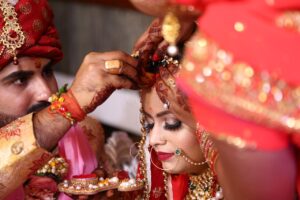
MARRIAGE AND DIVORCE
CONDITIONS FOR HIGH COURT PROTECTION
- Neither party should have a living husband or wife. Any previous marriage should no longer be valid. Means if any party was earlier married then he / she need to take proper divorce from their earlier spouse.
- Both parties should be competent to give valid consent. Both parties needed to be major in age and sound mind. The Groom must have completed 21 years and the Bridegroom must have been crossed 18 years of age.
- Parties who wished to perform marriage must not be within relations with each other like anyone cannot married daughter of his Paternal Uncle (Chacha), Maternal uncle (Mama) Paternal Sister (Bua) and Maternal Sister (Mausi), these are prohibited relationships.
- There is no need for parents’ approval of a court marriage, so long as the following conditions are fulfilled.
NECESSARY DOCUMENTS TO PERFORM LOVE MARRIAGE / INTER-CASTE MARRIAGE –
1) Age proof of both Bride and Bride Groom, this could be 10th mark sheet, voter ID Card, PAN card, Ration Card etc.
2) UID AADHAR Card of bride and grooms, without AADHAR card, Protection petition can not be filed in Punjab and Haryana High court.
3) Photographs of marriage Ceremony.
4) An application to local police station for safety and liberty of married couple.
OUR SERVICES IN RELATION TO MARRIAGE AND DIVORCE
Love marriages are a universal phenomenon celebrated across the globe, but in Punjab and Haryana, couples, who are perfoming love marriages without consent of their families or socital approval, faces significant challenges, when they choose to marry for love. Cultural norms and societal pressures can make it difficult for these couples to live peacefully and safely in their own homes. Advocate Vikram Singh and Associates are one of best advocte in Punjaba and Haryana High court, in protecting the rights and safety of such couples. We work tirelessly to ensure that newly married couples receive legal protection for their life and liberty by securing protection orders from the Punjab and Haryana High Court at Chandigarh. Our goal is to help couples live without fear, with the assurance that their rights are legally defended and their safety is our top priority.
CONCLUSION-
In most cases, the Hon’ble High Court directs the local Superintendent of Police to provide protection to runaway couples. This ensures their life and liberty are safeguarded. When couples feel unsafe returning home, they can stay in protection homes. These homes are available in every district of Punjab and Haryana, offering a secure space away from threats.
Advocate Vikram Singh and Associates, a leading advocate in Chandigarh, has wide experience in such matters. We regularly represent clients in the Punjab and Haryana High Court, Himachal Pradesh High Court, and Delhi High Court. Our legal services have helped many couples start their new lives with confidence and peace.
We don’t just offer legal support—we also provide legal advice and counseling. These services help couples resolve internal disputes and build trust. Whether you’re searching for divorce lawyers in India or need protection-related help, our team offers reliable solutions focused on long-term peace and legal security.
Best Divorce lawyer in Chandigarh
OUTLINE OF DIVORCE ACTS AND PROCEEDINGS
In Our Country, marriage and divorce are governed by different laws based on religion. Therefore, Hindus, Muslims, Christians, Sikhs, and others follow separate personal laws for marriage and separation. For example, Hindu couples follow the Hindu Marriage Act, while Muslim couples follow Muslim Personal Law, and Christian couples follow the Christian Marriage Act. If the marrige is inter-relgion then Special marriage Act would came in motion.
As a result, divorce laws in India are not the same for everyone. Each religion has its own legal rules, rights, and procedures. Moreover, a divorce in India can take place in two ways under Hindu Marriage Act, which is applicable for Hindu, Sikhs, Jain and some other Communities :-
-
With Mutual Consent – when both partners agree to end the marriage under section 13-B of Hindu Marriage Act, 1955.
-
Without Mutual Consent – when one partner wants a divorce, but the other does not, leading to a contested case in court. Under section 13 of Hindu Marriage Act, 1955, on various grounds provided under the act.
Both types of divorce have different legal steps and timelines. Therefore, it is important to get proper legal guidance before starting the process.
If you or someone you know is facing a divorce issue, consulting a legal expert is the best step. A Top Divorce lawyer in Chandigarh can guide you based on your specific religion and case type. If you’re searching for the best divorce lawyer in Chandigarh, choose someone experienced in all types of matrimonial matters like mutual divorce, contested divorce, child custody, and maintenance cases.
With the right legal support, the entire process becomes simpler, quicker, and stress-free.
TYPES OF DIVORCE PETITIONS IN INDIA
DIVORCE WITH MUTUAL CONSENT: Where both spouses agree to separate amicably with consent of each other. It is filed under section 13-B of Hindu Marriage Act. The following conditions must be met:
I. The couple must have been living separately for at least one year (Hindu law) or two years
(Christian law).
II. They must prove they have not lived as husband and wife during this period.
III. Both parties need to mutually agree on matters like child custody, alimony, and division of
property.
IV. The time frame for a mutual consent divorce typically ranges from six to 18 months, depending
on the court’s decision.
LEGAL GROUNDS FOR DIVORCE (HINDU AND CHRISTIAN LAWS)
Adultery IN MARRIGE AND DIVORCE
Adultery refers to a married person engaging in a consensual sexual relationship with someone other than their spouse. In the case of Joseph Shine v. Union of India (2018), the Supreme Court of India decriminalized adultery but held that it remains a valid ground for divorce. The Court emphasized that “adultery is a ground for divorce, as it undermines the sanctity of marriage and amounts to a violation of trust between spouses.” If one spouse has committed adultery, the innocent party can file for divorce by proving the act of infidelity. While direct evidence is often difficult to obtain, circumstantial evidence and proof of opportunity to commit adultery are usually sufficient in the eyes of the court.
CRUELTY IN CASES OF MARRIAGE AND DIVORCE
Cruelty is a valid ground for divorce and includes both physical and mental suffering caused by one spouse to the other.
Legal Perspective
In the case of Samar Ghosh v. Jaya Ghosh (2007), the Supreme Court explained that cruelty covers any act causing mental agony, harassment, or emotional injury. The Court stated that mental cruelty can include neglect, indifference, or abusive behavior that emotionally harms a spouse and makes it difficult to continue the marriage.
Application in Divorce Cases
Repeated abuse, domestic violence, insults, or humiliation can be seen as cruelty. The court looks at the full circumstances of the marriage, the emotional impact on the victim, and whether a reasonable person would view the treatment as cruel.
DESERTION IN CASES OF MARRIAGE AND DIVORCE
Desertion is the act of one spouse abandoning the other without any reasonable cause, consent, or intention to return. To seek a divorce on the grounds of desertion, the petitioner must establish that the desertion has continued for a statutory period of at least two years and that there was no justifiable reason for the spouse’s departure from the marital home.
BIGAMY IN CASES OF MARRIAGE AND DIVORCE
Bigamy happens when a married person enters into a second marriage while the first marriage is still legally valid.
Under Section 17 of the Hindu Marriage Act, 1955, bigamy is strictly prohibited. The law states that the second marriage is null and void. Courts have also confirmed that marrying again while the first marriage still exists is both a criminal offense and a valid ground for divorce.
If a spouse remarries without legally ending the first marriage, the other spouse can file for divorce on the ground of bigamy. The burden of proof lies with the petitioner. They must show that the second marriage took place while the first marriage was still in force.
CONVERSION OF RELIGION ITS EFFECT ON MARRIAGE AND DIVORCE
Conversion of religion refers to one spouse adopting a new religion that is different from the one professed at the time of marriage. Legal Perspective In Sarla Mudgal v. Union of India (1995), the Supreme Court held that conversion to another religion without the spouse’s consent amounts to a valid ground for divorce under the Hindu Marriage Act.
The court stated, “conversion to another faith fundamentally alters the basis of the marriage and creates grounds for seeking a decree of divorce.” Application in Divorce If one spouse converts to a different religion, the other spouse has the right to file for divorce, as the conversion could lead to a conflict in personal laws governing the marriage. The petitioner must demonstrate that the conversion has substantially affected the marital relationship.
Understanding the various divorce laws under Hindu and Christian statutes is essential for individuals seeking a fair resolution. Consulting experienced legal professionals, like those at Advocate Vikram Singh and Associates, ensures the best guidance in navigating complexities of divorce proceedings.